A warming fridge is a countdown clock, so refrigeration calls jump our weekday queue. Weekday visits across the Tri-Cities with a written price before work begins.
A warming fridge is a countdown clock, so refrigeration calls jump our weekday queue. Most failures land in three systems — defrost (frost where it shouldn't be), airflow (one compartment cold, the other not), or the sealed system's support cast: start relays, capacitors, fans and thermostats. We carry parts for all three and test in a set order that finds the fault fast.
Side-by-side, French door, top-freezer, garage beer fridge — we work on them all across Kennewick, Pasco, Richland, West Richland and Benton City. If the compressor itself has died, we'll tell you before you spend real money, not after.
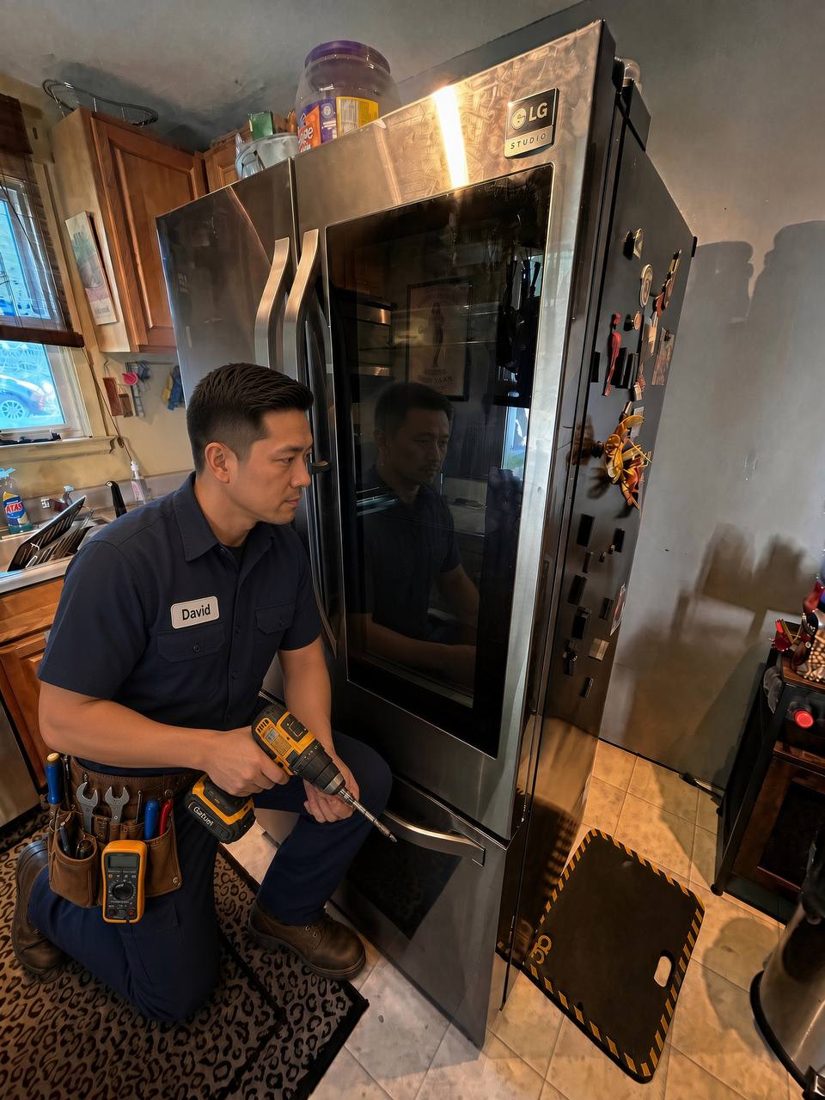
Textbook defrost failure or a blocked air damper. Frost seals off the vents that feed the fresh-food side. Very repairable.
The start relay trying and failing to launch the compressor. Caught early, it's an inexpensive part that saves the compressor.
A frozen defrost drain backing up. We clear the drain, heat-treat the line, and it stays fixed.
Inlet valve, jammed ejector or supply-line freeze-up. Also see our dedicated ice maker page — it's its own discipline.
A door gasket losing its seal or a defrost heater out. Humid summer air plus a tired gasket builds frost fast.
Condenser coils packed with dust and pet hair, or a fan motor on its way out. Both show up plainly on inspection.
Applies to the repair price, not the $99 diagnostic (which already credits toward the repair). One coupon per visit; can't be combined with other offers.
Call or leave a request — we confirm a weekday arrival window that fits your schedule.
A background-checked technician arrives inside the window with parts for the common failures.
You get one written price before any work starts. Take it or leave it — no pressure.
Most jobs wrap the same visit, and the $99 diagnostic folds into the bill.
A fridge that warms while its freezer stays cold almost always hides a frost dam over the evaporator. We pull the back panel, document the ice pattern — its shape tells us which defrost component quit — then thaw the coil properly with steam rather than hacking at it. The failed heater, defrost thermostat or control gets replaced and we verify the repair by forcing a defrost cycle and watching current draw. You get airflow back the same visit, and the frost doesn't return next month.
Rhythmic clicking from the back of a warm fridge is the start relay failing to launch the compressor — and every failed launch cooks the compressor windings a little more. The relay and capacitor swap is quick and sits at the bottom of our refrigeration range, but timing matters enormously: caught this week it's a modest repair, ignored for a month it can take the compressor with it. We test compressor windings before and after so you know the save actually landed.
Each fridge runs two fans, and each fails differently. A dead evaporator fan starves the fresh-food side of cold air and often squeals behind the freezer wall first; a dead condenser fan makes the compressor run hot and long, and the whole cabinet feels warm at the grille. We replace the failed motor, clean the coil it serves while the panel is off, and check door gaskets for the air leaks that made the fan work overtime in the first place.
Refrigerant loops are the one repair where honesty saves you the most money. A compressor or a sealed-system leak on a standard kitchen fridge usually costs more than the machine justifies, and we say that at the diagnostic — before parts, before hours. On built-ins and premium units where the math works, we'll quote it straight with certified refrigerant handling. Either way you get a real verdict for $99, not a five-hundred-dollar experiment.
Water on the floor, hollow cubes or a silent dispenser all live on the same path: inlet valve, fill line, reservoir, dispenser chain. Kennewick-area scale hits this path first, freezing valves partway and letting fill lines ice solid. We trace the path end to end, thaw and correct frozen sections with the cause fixed — not just melted — and swap scaled valves. The dispenser side, auger to chute flap, gets tested in the same visit under the same diagnostic.
Warm milk with no frost, no clicking and both fans running takes actual instrumentation: we log compartment temperatures, check thermistor resistance against spec, test the damper's travel, and read the control's sensor values in service mode. Half these calls end at a drifted thermistor or a stuck damper — inexpensive parts that cheaper visits miss entirely by quoting a control board on a hunch. The methodical hour is what the diagnostic fee actually buys.
Keep the doors shut — a loaded fridge holds safe temperature for around four hours sealed, and a full freezer holds a day or two. Move milk, meat and medicine to a cooler with ice, and don't add warm groceries. Booking a weekday morning slot usually gets us there inside that window.
On a newer sealed-system-warrantied unit or a built-in worth four figures, sometimes yes. On a typical eight-to-twelve-year-old kitchen fridge, the part plus certified refrigerant labor usually crosses the half-of-new line, and we'll say so at the diagnostic before you're out anything but the fee.
Tri-Cities garages can swing past a hundred degrees, and standard refrigerators are rated for far milder rooms. The compressor runs continuously, seals bake, and thin margins fail. We repair what's failed and tell you honestly whether that unit will survive the location.
Different fault, same visit. Over-cooling usually points to a stuck damper, a failed thermistor or a control board misreading temperature. It's diagnosable with the same meter-first process, and the fix typically lands at the lower end of our price band.
Yes — Sub-Zero-style built-ins, counter-depth French doors and integrated columns included. Panels and clearances make these slower to open up, which the quote reflects, but the failure patterns are the same physics as any other fridge.
Home turf — the shop is on W 4th Ave, so Kennewick slots fill first.
Call (509) 841-9131 or send the form above — weekday windows book fast, same-day when routes allow.