A dead washer turns into laundromat trips fast, so we run washer calls on a tight loop: diagnose with a meter and the service manual, quote one written number, fix it the same visit whenever the part is on the van. Weekday visits across the Tri-Cities with a written price before work begins.
A dead washer turns into laundromat trips fast, so we run washer calls on a tight loop: diagnose with a meter and the service manual, quote one written number, fix it the same visit whenever the part is on the van. Drain pumps, inlet valves, door lock assemblies, shock absorbers and belts all travel with us.
Front-load, top-load, high-efficiency, stackable — we service the machines Tri-Cities homes actually own, from Whirlpool and LG workhorses to Samsung units with cryptic error codes. If your washer flashes a code, snap a photo and read it to us when you book; it often shortens the visit.
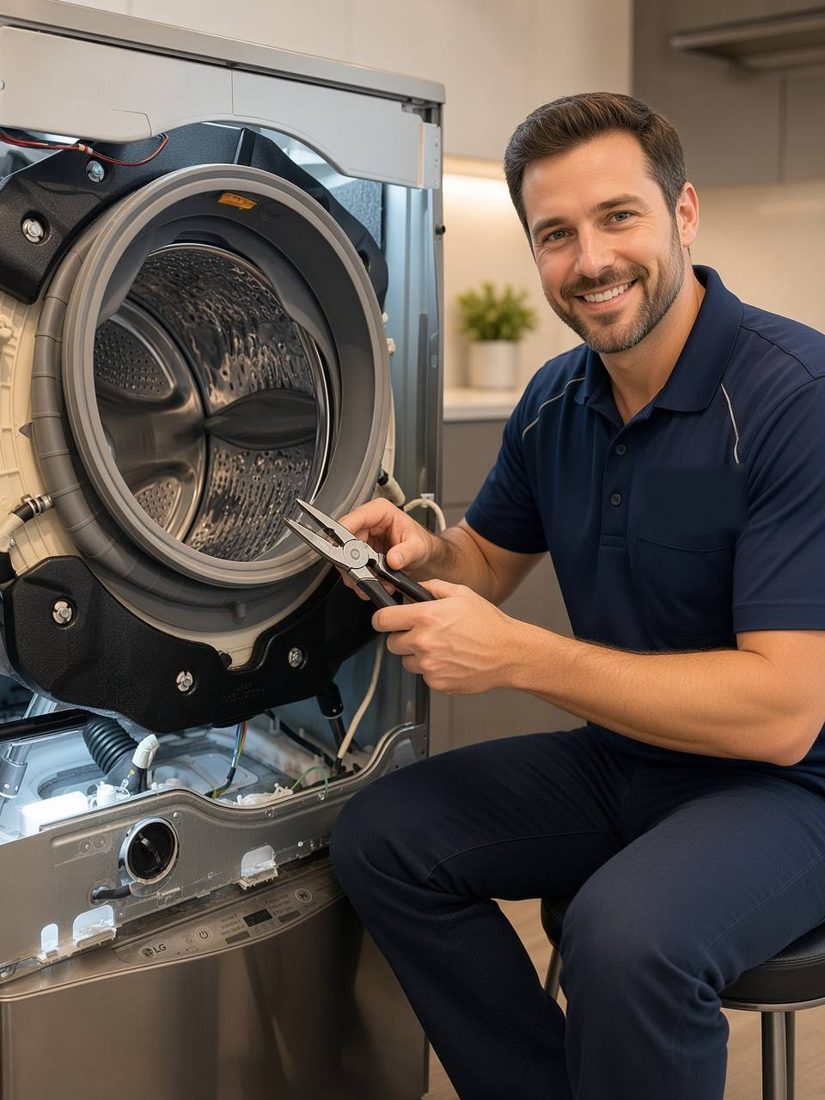
Door boot seals on front-loaders, cracked drain hoses, or a leaking pump. We pressure-check rather than guess, because 'leak' has a dozen sources.
A drain pump jammed with a sock or coin is the classic. Lid switches and shifter assemblies come next. All quick to confirm.
Worn shocks or suspension rods, or a load-sensing fault. We rebalance and replace the tired hardware — the shaking is fixable, not a personality trait.
Each brand hides different failures behind its codes. We carry the decode references and test the flagged component instead of swapping blind.
Inlet valve screens plugged by sediment — common on Kennewick's harder water — or a failed valve solenoid. Minutes to test.
Motor, belt or control fault. The diagnostic tells us which, and the quote comes before any teardown.
Applies to the repair price, not the $99 diagnostic (which already credits toward the repair). One coupon per visit; can't be combined with other offers.
Call or leave a request — we confirm a weekday arrival window that fits your schedule.
A background-checked technician arrives inside the window with parts for the common failures.
You get one written price before any work starts. Take it or leave it — no pressure.
Most jobs wrap the same visit, and the $99 diagnostic folds into the bill.
A washer that stops full of water usually flags a drain fault code first. We drain the tub with our own pump, open the filter housing — where a coin, sock or bra wire is waiting more often than not — and test the pump winding with a meter. Debris-jammed pumps sometimes survive; burned ones don't, and the meter tells us which story we're in. The new pump goes in, hoses get fresh clamps, and the machine runs a full drain-and-spin with us watching the flow before we load the van.
Slow fills around here trace to mineral scale more often than any electrical fault. We pull both hoses, photograph the screens if they're crusted — owners deserve to see the culprit — and test each solenoid winding. A screen clean is free inside any visit; a scaled-open or scaled-shut valve gets replaced with the hoses re-torqued and a fill test through both temperatures. We'll also tell you plainly whether a whole-house sediment filter would stretch the next valve's life.
A front-loader that won't start, or locks and sulks, usually has a failed door lock assembly — they take a beating from every slam and steam cycle. Top-loader lid switches die the same death. We confirm through the control's diagnostic mode, replace the assembly, and cycle the lock a dozen times including a mid-cycle interruption, because intermittent lock faults love to hide from single tests. If a wiring harness connector is the real problem, you pay for a connector, not an assembly.
A banging spin cycle means the suspension can no longer keep the tub centered — shocks on front-loaders, suspension rods on top-loaders. We replace them as a full set; one new shock against three tired ones just moves the bang to a different corner. Feet get leveled and locked, and if the machine lives on a springy laundry-room floor we'll say so, because geometry we can't fix shouldn't be quoted as parts you don't need. The test load is a real one: towels, high spin.
A jet-engine spin cycle is the tub bearing announcing the end. On some machines the bearing presses out and the repair pencils; on many, the manufacturer sells only a complete outer tub, and the labor makes the total absurd against the machine's value. We diagnose it for the standard fee, give you the real number, and recommend against it when the math is bad. Roughly half our bearing calls end with us advising a new machine — and the diagnostic credit still applies if we fix anything else instead.
Modern washers self-report generously if you know the handshake. We enter service mode, pull the stored code history, and test the specific component the code implicates — a shifter, a sensor, a pressure switch — before any talk of boards. Control boards are the last suspect, not the first, because they're the priciest and the most commonly mis-blamed part in the trade. When one truly has failed, the quote includes reprogramming and a full multi-cycle test.
Sometimes, but honestly not always worth it. On many front-loaders a bearing job means splitting the outer tub — hours of labor — and on some models the tub is sold only as an assembly. We'll quote it straight and tell you when the smarter money goes toward a new machine.
Residue from low-temperature washes feeds mildew in the door boot and drum. We clear the drain filter, check the boot, and hand you a maintenance routine — an empty hot cycle with washer cleaner monthly and the door cracked between loads. If a part is holding water where it shouldn't, we'll find it.
Yes, and we also look at why it drifts. Feet back off on vibrating machines, and pedestal-mounted front-loaders on flexible laundry-room floors amplify every out-of-balance load. We level, lock the feet, and replace worn dampers so the machine stops re-loosening itself.
If a hose clamp or lid switch failed — sure, that's a modest fix with years of life gained. If the transmission or motor died on a bargain-tier machine, the math rarely favors repair, and we'll show you the numbers instead of talking you into anything.
Leave it as it failed — water, laundry and all. Seeing the machine mid-fault often speeds the diagnosis, and we bring a pump and wet-vac to drain it cleanly. Just clear a path to the laundry area and we'll handle the rest.
Home turf — the shop is on W 4th Ave, so Kennewick slots fill first.
Call (509) 841-9131 or send the form above — weekday windows book fast, same-day when routes allow.